
A digitizer is a critical component for industries that want to move from analog operations to digital workflows and leverage modern technologies to analyze data from their physical assets.
In modern industry, everything is increasingly connected to the internet and monitored to ensure optimal operation, maintenance, and growth. Yet many companies still rely on analog systems and signals that remain largely untapped. This is where a digitizer comes into play. It acts as a bridge between analog and digital systems, enabling valuable data to be extracted from sensors and equipment that previously could not be analyzed.
Digitizers are sometimes compared to traditional signal converters, but the distinction is important. A signal converter typically transforms one analog signal into another, easier-to-work-with analog signal, for example, converting PT100 to mA. A Digitizer, by contrast, is a complete device. It includes an integrated signal conditioner, an ADC (analog-to-digital converter), a microprocessor, a battery, and a radio for wireless communication.
In short, a Digitizer converts an analog signal into a wireless digital data packet and transmits it directly to the Neuron Cloud.
Neuron Digitizer benefits
What makes Digitizers especially useful in practice is their ability to connect to existing analog signals without interfering with other equipment that uses the same signals, such as a local PLC. They can also be used to connect specialized sensor variants to Neuron Cloud by utilizing the sensor’s analog output.
Digitizers are also inherently galvanically isolated. The sensor shares the same electrical potential as the measured object, while the wireless communication is fully electrically isolated. This ensures safe integration without the risk of interference or noise in the installation.
We offer a broad portfolio of Digitizers capable of capturing physical data from analog sources such as:
- mA
- Vdc
- mV
- Dry contacts
- Potentiometer
- Pulse counting
- Hour counting
- Thermistors (PT100) and thermocouples (Type K)
In addition, the Neuron portfolio includes a range of standardized sensors where the sensing elements themselves are integrated components. These include vibration sensors, pressure sensors, and temperature sensors, depending on the insight you need. These are ready-made, rugged measurement units that deliver data directly, with no additional customization required.
In this article, we take a closer look at all the Digitizers in the Neuron family, how they are used in practice, and what types of measurements they enable for you and your organization. The goal is to help you quickly understand which Digitizer fits where, and how each one can strengthen your digital processes.
mA
The milliampere (mA) current loop is the most widely used analog signaling method in the process industry, for good reason. mA signals are independent of cable length, highly resistant to electrical noise, easy to interpret, capable of powering the sensor through the same signal cable, and include built-in fault detection for both cable breaks and short circuits.
Most mA loops operate in the 4–20 mA range, where the loop current represents a measured value. A signal of 4 mA typically corresponds to 0 percent, while 20 mA represents 100 percent. A value of 12 mA, therefore, indicates 50 percent. Simple, stable, and predictable.
Some installations use alternative ranges such as 5–25 mA or 0–20 mA. Neuron mA Digitizers can read signals from 0–25 mA, covering all common variants without the need for special configuration.
mA Digitizers are connected directly into an existing loop, or to an instrument that provides an mA output.
Read more information on installation here!
mA Digitizers are used wherever an mA loop needs to be read digitally. This may be within an active control loop, from a sensor probe that is difficult to access, or from a new sensor you want to connect to the network in a simple and efficient way.
Vdc
DC voltage (Vdc) is another widely used analog signal format, most commonly in the ranges 0–10 V or 0–5 V. Vdc is frequently used with variable frequency drives and HVAC sensors, typically mapped to a 0–100 percent measurement range where 0 V represents 0 percent and 10 V represents 100 percent.
Vdc signals are easy to use and troubleshoot, and they do not require a minimum loop current. This makes them particularly well-suited for battery-powered sensors.
Vdc Digitizers are often used to monitor control voltages in automation systems and also function as effective battery monitors for systems operating between 1.5 V and 24 V.
In addition, a Vdc Digitizer has high input impedance, which in most cases allows it to be connected directly to existing measurement points without affecting other equipment.
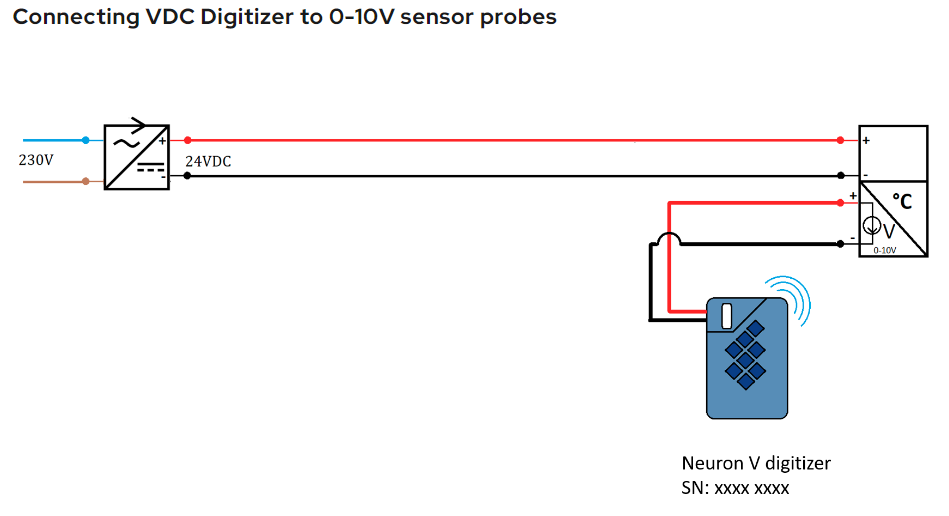
Read more information on VDC digitizer installation here!
mV
Millivolt (mV) signals are low-voltage signals that are most often derived from a shunt carrying high current. In this case, the mV signal represents the actual current and has traditionally been connected to iron-core instruments that convert the signal into an analog display.
mV is also used to monitor voltage drops across contact points and as a measurement signal from chemical probes, such as oxygen or salinity sensors.
An mV Digitizer has high input impedance and can usually be connected directly to existing measurement points without influencing other equipment.
Read more information on digitizer installation here!

Dry contacts
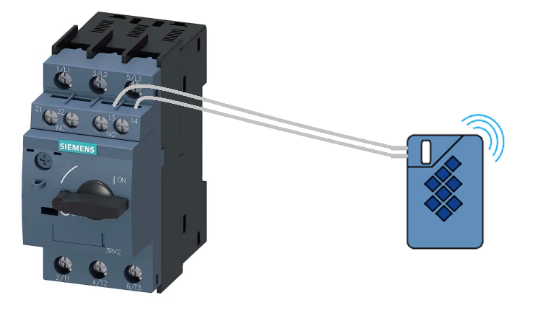
Dry contacts are electromechanical outputs that do not generate voltage or current on their own. To be read, they must therefore be supplied with a small voltage within the measurement loop. Relay outputs, auxiliary contacts on contactors, pressure switches, bimetal switches, reed relays, and various types of mechanical switches are typical examples of equipment with dry contact outputs.
Dry Contact Digitizers measure and report the status of these outputs by sending a very small current, 0.1 mA, through the circuit and then detecting whether it is open or closed.
Limit switches, relay outputs from PLCs or monitoring systems, status monitoring of surge protectors or ground fault devices, float switches, and door position switches: the applications are many, but the solution is the same. A Dry Contact Digitizer provides simple and reliable status monitoring.

Potentiometer
Many sensors used to measure position, angle, distance, rotation, or height rely on resistive elements as their signal source. These outputs are measured in ohms, typically in the range from 1 kΩ to 100 kΩ, where the resistance corresponds to a physical value such as millimeters of movement or degrees of rotation. These signals normally need to be converted to current or voltage before a digital system can read them.
The Neuron Potentiometer Digitizer handles this entire digitization process. The device includes its own voltage supply, which energizes the resistive loop during measurement. The result is transmitted digitally as a signal with steps from 0 to 8192, with a resolution of one step. This provides very high precision and enables measurements down to the micrometer scale.
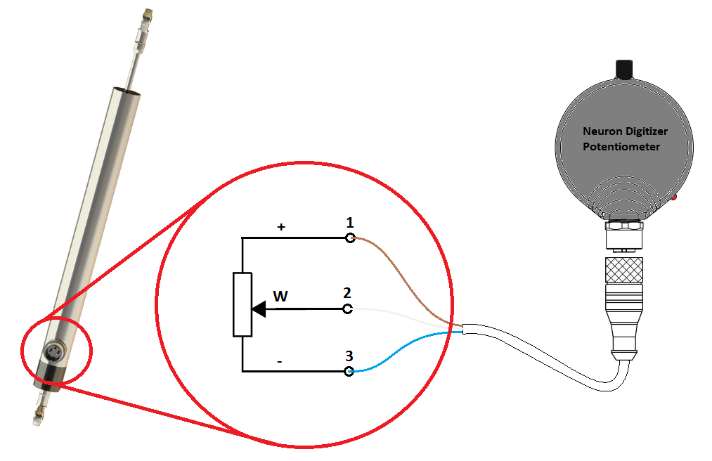
Typical applications include detection of linear movement and position, as well as measurement of angle and rotation.
Pulse counting
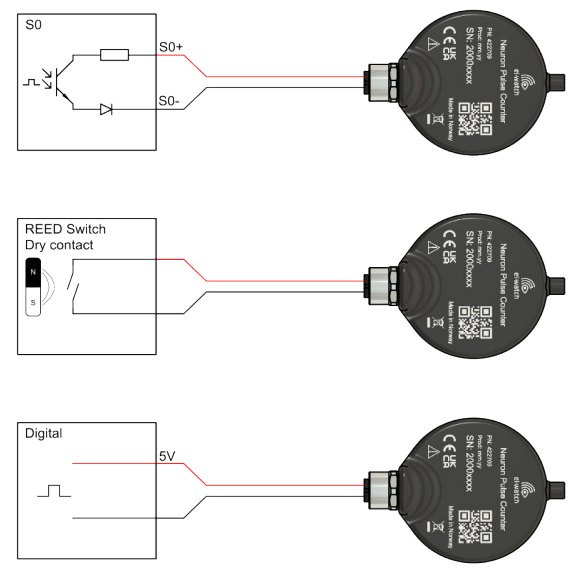
For instruments and sensors that measure consumption, pulse-based signaling is very common. A typical example is energy consumption, where a meter may generate 1000 pulses per kWh. This type of signaling is especially useful for accumulating consumption over time and gaining insight into operational costs, whether for energy, water, or compressed air.
The Neuron Pulse Counter is a complete device that captures and accumulates these pulses. It can read directly from an S0 output or from a 24 V pulse source using a Pulse Level Converter. This provides a simple and accurate way to digitize consumption measurements.
Hour counting
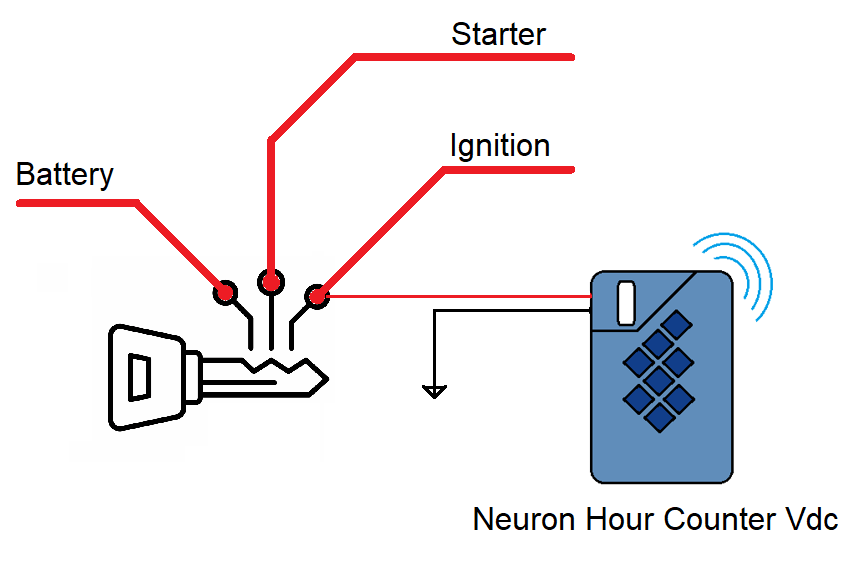
Hour counting is used to gain insight into the actual operating time of equipment. Whether it is a compressor, an electric motor, or a forklift, runtime is critical for predicting maintenance needs and optimizing asset utilization. Many hour meters are integrated into larger machines, such as forklifts or excavators, and increment in line with engine runtime. The challenge is that these counters often have to be read manually and locally.
The Hour Counter VDC is a specialized Digitizer that converts operating voltage directly into accumulated operating hours. A defined voltage level, 4 V, starts the hour count. If the voltage remains above 4 V for one hour, the counter increases by one hour. If the voltage drops below 4 V, accumulation stops for that period.
Neuron Hour Counters continue counting even if no gateway is nearby. If the device has been offline while the runtime increased, it reports the updated hour value as soon as the connection is restored.
The Neuron Hour Meter Vibration Sensor records operating time whenever vibration levels rise above 50 mg. The total runtime is stored internally, allowing the sensor to operate without continuous connectivity to a gateway. Once the device reconnects to a gateway, the accumulated operating time is automatically sent to the Neuron Cloud.
The sensor measures vibration once per minute and transmits data every two minutes.
The Neuron Hour Meter Vibration sensor allows you to digitize equipment uptime by tracking operating hours based on vibration activity. It accumulates elapsed time whenever vibration exceeds a defined threshold. This operating time is stored internally, enabling the sensor to function even when it is out of range of a gateway. Once the device comes within gateway range, the recorded elapsed time is automatically transmitted to the Neuron Cloud.
Thermistors (PT100) and thermocouples (Type K)
Temperature probes such as thermistors (PT100) and thermocouples (Type K) are commonly used to measure temperature in industrial processes. Because these sensors generate very weak signals, signal conditioners typically convert the signals into mA outputs before sending them to a PLC or other control system. This improves noise immunity and measurement stability.
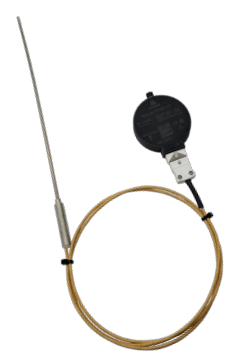
Neuron PT100 and Neuron Thermocouple Type K units can be supplied as standalone devices for connection to existing sensor probes in your installation, or as interfaces for new probes that you source yourself. We can, of course, also supply probes if required. In all cases, the probes connect directly to the IEC connector on the Digitizer, and measurement starts immediately.
Temperature is one of the most fundamental and widely used measurement parameters in industry, and a Digitizer makes it easy to digitize temperature data reliably and consistently.