


Humidity sensors provide operations teams with a straightforward tool to protect quality, reduce energy waste, and prevent downtime.
This guide explains what humidity sensors measure, how the main technologies differ, how to choose and place them, and where they deliver the most value in your industry.
You will also learn how El-Watch’s Neuron devices integrate into typical plant environments and how to convert measurements into alarms, reports, and actionable insights.
Related article: Wireless temperature sensor: A remote control for industrial gains
What are humidity sensors? Key parameters explained
Humidity is moisture in the air. We can describe it in three practical ways:
- Relative humidity (RH): RH compares how much water vapor is in the air to how much it could hold at the same temperature. Because warm air can hold more moisture, RH always depends on temperature. A room with the same moisture load can be safe at 24 °C yet form condensation on a 12 °C surface.
- Absolute humidity (AH): AH is the actual mass of water per volume of air (for example, g/m³). It does not depend on temperature. AH is helpful when the temperature varies, but the moisture load needs to stay constant across zones or seasons.
- Dew point: Dew point is the temperature at which the current air will start condensing on a surface. If any surface is colder than the dew point, it will likely form water, frost, or ice.
In practice, RH is the most intuitive metric for rooms, processes, and products because it reflects the environment your materials “feel.” Dew point is the most actionable metric where cold surfaces exist (coils, pipes, doors, compressed-air lines). AH is the right lens for air handling and seasonal comparisons.
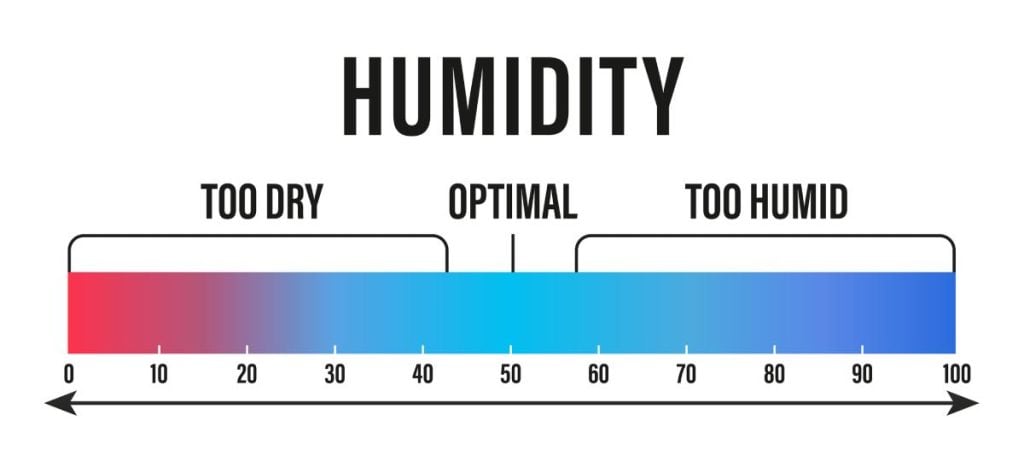
Modern platforms, including the Neuron App, can derive dew point and AH from measured RH and temperature, so you can view the metric that best predicts risk while logging the original measurements for traceability.
Learn more: El-Watch Neuron Sensors: A sixth sense for IoT monitoring
Sensor types and trade-offs
Humidity sensors use different physical principles. The choice affects accuracy, cost, and maintenance:
- Capacitive RH sensors: A thin polymer film changes capacitance as it absorbs moisture. These sensors are widely used in industrial and building applications due to their accuracy, stability, compactness, and low power consumption. They pair well with wireless deployments. Use protective filters in areas with dust or where washing down is required.
- Resistive RH sensors: Resistance changes in response to moisture. They are low-cost and robust, but their accuracy tends to shift over time, and they usually cover a narrower calibrated range. Suitable for non-critical monitoring or where budget and simplicity are the primary concerns.
- Chilled-mirror hygrometers: A mirror is cooled until condensation forms, providing a primary standard dew point. Accuracy is excellent. Cost and maintenance are high. Best for calibration labs or critical test stands, not for wide wireless fleets.
- Dew-point transmitters (polymer/oxide): Specialized probes read dew point directly in gases such as compressed air. They are compact and rugged with mid-to-high cost. Use for dryers, air quality in pneumatics, and high-value processes.
Each technology has variants and packaging for environments from cleanrooms to washdown production. In many facilities, a capacitive RH+temperature probe covers most rooms and enclosures, while a dedicated dew-point probe covers compressed air.
Learn more: Monitoring Dew Point
Choosing the right humidity sensor: essential specs
Before you buy or standardize, match specifications to the job:
- Accuracy and range: Confirm RH accuracy across your operating temperatures and moisture levels. A sensor that measures ±2% RH at 25 °C may be less precise at 5 °C or 60 °C. Check the temperature range for both the electronics and the probe.
- Response time: Door openings, washdowns, and short cycles can change humidity quickly. Faster response captures these transients and supports trend alarms.
- Ingress protection and materials: IP ratings and probe construction are crucial in environments with dust, moisture, or chemicals. External, overmoulded probes are helpful when you must place the sensing tip inside ducts, enclosures, or near cold surfaces.
- Power and connectivity: Battery life depends on the reporting interval and radio conditions. Gateways and cloud services should be simple to commission and stable in noisy RF environments.
- Calibration and drift: Plan how you will maintain accuracy: field calibration, swap-and-replace, or lab checks. Look for documented stability over time.
- Data and alarms: Confirm that you can set thresholds, trend alarms, and notifications to the right people via push, email, or SMS, and that exports meet audit requirements.
Neuron Humidity vs. Humidity IP67
El-Watch offers two complementary options:
- Neuron Humidity: A wireless RH+temperature sensor for indoor and controlled environments such as offices, labs, and standard production zones. With an IP21 rating, it is quick to deploy and ideal where an integrated probe is sufficient and washdown is not required. See the product page here for detailed specifications and operating limits.
- Neuron Humidity IP67: A wireless RH+temperature sensor with an IP67-rated external probe for demanding sites. The overmoulded probe withstands wet, dusty, and washdown conditions, and can be positioned inside ducts, cabinets, or close to cold surfaces, while the body remains protected. It reports at regular two-minute intervals for timely alarms and trending. Thresholds are set in the Neuron App, and the device connects to the Neuron Cloud via a Neuron Gateway. For full specifications, see the Neuron Humidity IP67 product sheet here.
Choose the standard Neuron Humidity where the environment is clean and access is easy. Choose the IP67 variant where protection, flexible placement, or washdown is required.
ROI and energy impact: cutting scrap, downtime, and energy loss
Humidity control pays off in three ways:
1. Quality yield
Many materials equilibrate with ambient moisture. Timber warps, paper curls, powders cake, coatings blush, flux residues activate, and steel flash-rusts when RH strays. Stable humidity shortens cycles, improves adhesion and finish, and reduces rework.
2. Uptime
Condensation and frost trigger stoppages. Ice on coils can lead to short cycling and service calls. Moisture in compressed air sticks valves and damages tools. Early alarms on RH trends or falling dew-point margin prevent these events before they force downtime.
3. Energy
Plants often overshoot dehumidification “just to be safe,” wasting energy. Better sensors near the product tighten deadbands, allowing you to run fewer defrosts, lower reheat, and reduce over-drying. The net is lower kWh per unit produced and fewer after-hours fixes.
For many sites, the gains come from simple actions, such as door discipline in cold rooms, adding or relocating a sensor to capture a known hotspot, or retuning humidification setpoints after seeing real trend data.
Related article: Refrigeration monitoring: Financial & environmental sustainability in one
Installation and placement—best practices
Good placement turns measurements into accurate decisions. Position sensors where conditions represent the product, not the supply jet. Mount the product at its recommended height, away from direct radiant heat or sunlight.
In large rooms or where gradients are likely, near doors, corners, or mezzanines, use multiple sensors to capture the true range.
In washdown or dusty areas, use protected probes and the IP67 variant. When you need to monitor inside a cabinet or duct, place the external probe at the target point and mount the body in a location that stays dry and is easily accessible.
Pair humidity with temperature. RH and temperature form a single signal; a temperature change can cause RH to change without any change in moisture load.
During commissioning, compare readings to a reference or use a salt-solution check, then log at least a week to learn the typical daily pattern before tightening alarms. Label sensors clearly in the Neuron App so that operations can act quickly when an alarm is triggered.
From data to action: alarms, trends, and integrations
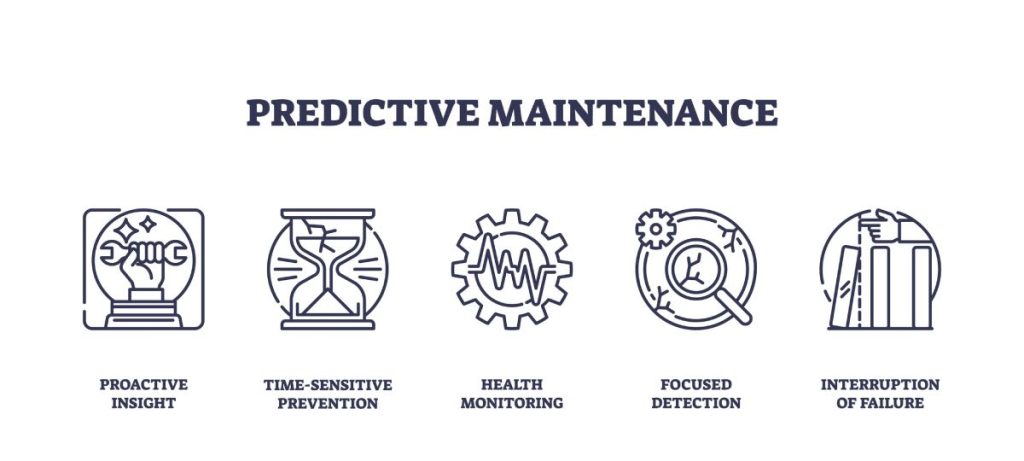
Start with simple bounds for each critical area, then add context by setting upper and lower RH limits that reflect your process window. Add trend alarms that trigger when RH is rising fast or when the dew-point margin to the coldest surface is shrinking.
These predictive alarms warn earlier than fixed thresholds, giving time to adjust doors, loads, or setpoints.
Context matters. Overlay humidity with events such as door openings, defrost cycles, or compressor starts to identify root causes. If spikes always follow a particular shift change or a cleaning cycle, you know where to intervene.
Route alarms via push notification, email, or SMS to the on-duty team. For closed-loop work, integrate with BMS, SCADA, or CMMS to create work orders and log corrective actions. Reports should show time in spec, alarm history, and comments—useful for audits and for continuous improvement.
Learn more: How Sensor Integration in CMMS Boosts Profitability and Enhances Maintenance
Industrial use cases
Metal processing
Before and after surface treatment, moisture control protects finish quality. RH that is too high encourages flash rust and adhesion problems; too low can affect cure and film formation.
Place sensors near pre-treatment and drying zones, and track dew-point margin at cold points such as incoming parts, overhead doors, or chilled tooling.
The IP67 probe allows you to monitor inside enclosures or near spray and rinse areas while keeping the transmitter protected. Alarms on rising RH rate help you react before defects appear.
Cleanrooms
Powders, films, and precision assembly all rely on narrow humidity windows to reduce ESD risk, microbial growth, and moisture-driven variability.
Use multiple sensors to map the room, then hold a defined RH band. When the app shows that excursions follow shift changes or door cycles, tighten procedures instead of over-tuning equipment.
Reporting provides proof for ISO and GMP audits without the need for manual logbooks.
Cold chain
Frost and ice form when the dew point crosses the coil or the surface temperature. Monitor RH and dew point near doors and in far corners where airflow is weak.
Set an alarm if the dew point approaches the evaporator coil temperature to intervene before icing cuts capacity. Trend data often reveals simple fixes, such as better door discipline, a minor airflow adjustment, or relocating stock away from known cold spots.
The IP67 probe handles splash and washdowns common in these rooms.
Compressed air
Dryers and filters aim to keep the dew point at a safe level. A dew-point sensor downstream of the dryer confirms performance, while an RH+temperature sensor in the compressor room can warn of conditions that predict carryover.
Alarms on rising process-air dew point catch problems early, protecting valves, cylinders, and tools, and improving product quality where air contacts the process.
HVAC
In production offices, labs, and controlled areas, balanced humidification and dehumidification protect materials and maintain comfort while minimizing energy consumption.
Place sensors where occupants spend time and where materials are staged. Use time-in-spec reports to demonstrate conditions to customers and justify setpoint and schedule changes that save energy without compromising quality.
Concrete and paper
Curing and dimensional stability depend on ambient moisture. In concrete, consistent humidity shortens cure variability and reduces the likelihood of cracking. In paper and converting, stable RH reduces curl, jams, and mis-registration.
Map humidity across the line to identify micro-climates, then fix with airflow or localized conditioning rather than global setpoint changes that waste energy.
Food industry
Humidity drives dehydration loss, mold growth, and sugar crystallization. In proofers and dryers, stable RH improves repeatability and texture. In storage, controlling RH extends shelf life and reduces packaging waste from soggy or brittle products.
Place sensors near doors and in known areas of weak airflow, and set the alarm on the dew-point margin to keep coils free of ice.

The bottom line on humidity sensors
Humidity sensors are a small investment with an outsized impact. Choose the proper probe for the environment, place it where the product “feels” the air, and turn measurements into early warnings and clear reports.
For harsh areas or flexible probe placement, see Neuron Humidity IP67; for standard rooms and controlled spaces, see Neuron Humidity. In both cases, the Neuron App allows you to set thresholds and, when necessary, calculate dew point or absolute humidity for analysis and reporting.
Read more: FMEA: How to Use Failure Modes and Effects Analysis to Choose Sensors for Condition Monitoring